
Looking for a WeatherTech Alternative? Why AVS Ventvisor Delivers
WeatherTech window deflectors built a reputation for quality, but they're not the only name that deserves attention. We designed AVS Ventvisor deflectors with the same goals—fresh air circulation in any weather, UV protection, and a low-profile dark smoke finish—and engineered them to fit your exact year, make, and model without the premium price tag.
If you're shopping for WeatherTech alternative window deflectors, you're probably weighing fit accuracy, material durability, and whether another brand can deliver the same ventilation benefits without compromise. This guide walks through what makes a window deflector worth buying and why our Ventvisor line stands as a direct competitor to WeatherTech's lineup.

Material Quality and UV Resistance: Side-by-Side Construction
WeatherTech uses acrylic for its side window deflectors, marketed for impact resistance and UV stability. We use the same high-grade acrylic in every Ventvisor model, formed under heat to match door frame contours exactly.
Both brands apply UV inhibitors to prevent yellowing and cracking after years of sun exposure. The difference isn’t in the base material—it’s in how the deflector mounts and whether the manufacturer stocks replacement parts when a piece eventually chips. Our rain guards and deflector catalog includes every mounting clip and adhesive strip sold separately, so a damaged bracket doesn’t force you to buy an entire new set.
Thickness matters more than brand name. WeatherTech deflectors measure 3mm at the leading edge; ours match that spec, with the same tapered profile to reduce wind noise above 50 mph.
In-Channel vs Adhesive-Mount: Which Installation Method Fits Your Vehicle
WeatherTech offers both in-channel deflectors that slide into the window channel and adhesive-mount models that bond to the door frame with 3M tape. We mirror that lineup with two Ventvisor styles.
In-channel models install without adhesive, making them easier to remove for car washes or winter storage. They’re available for most sedans, coupes, and crossovers built after 2005. If your vehicle has a frameless window or flush door design, the in-channel Ventvisor option may not fit—check our vehicle selector before ordering.
Adhesive-mount deflectors bond directly to the painted or chrome door frame, creating a permanent seal that won’t shift at highway speeds. This style works for trucks, older vehicles, and any model where the window channel isn’t accessible. We include pre-applied 3M automotive-grade tape on every adhesive set, the same supplier WeatherTech uses.
Vehicle-Specific Fitment: How AVS Templates Compare to WeatherTech Databases
WeatherTech custom-molds deflectors for each vehicle application using laser-scanned templates of door frames and window channels. Our engineering team follows the same process—we scan vehicle doors, create CAD models, and injection-mold acrylic to match those exact dimensions.
Where the two brands differ is update frequency. WeatherTech typically adds new vehicle applications within three months of a model’s release. We aim for the same timeline, and for high-volume trucks and SUVs, we often ship deflectors before WeatherTech’s product appears on their site.
If you drive a niche vehicle or a brand-new redesign, cross-reference both fitment databases. WeatherTech’s catalog is broader for European imports; ours covers more trim variations for domestic trucks. A 2023 F-150 with crew cab and short bed requires different deflector dimensions than the same truck with a standard cab—both brands stock those variations, but availability windows shift throughout the year.
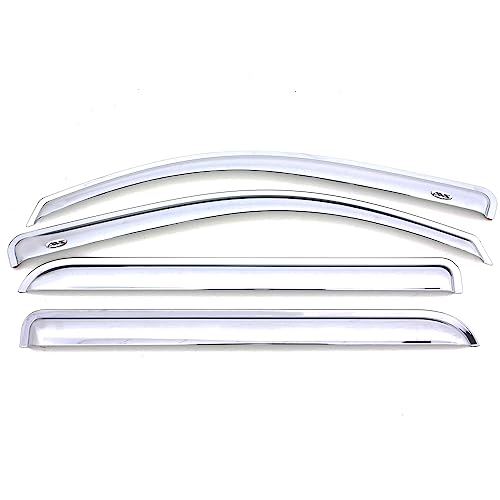
Price, Shipping, and Warranty: What You Actually Pay
WeatherTech window deflectors for a four-door pickup typically retail for $119 to $139 before shipping. Our equivalent Ventvisor set costs $89 to $109, shipped free to the lower 48 states when ordered directly from our site.
Both brands offer a limited lifetime warranty covering defects in materials and workmanship. WeatherTech requires you to register your purchase within 30 days; we don’t—your order confirmation serves as proof of purchase for any future claim.
Shipping speed varies by season. WeatherTech ships from Illinois; we ship from North Carolina. East Coast customers typically receive our deflectors within three business days. West Coast orders take five to six days via standard ground. If you need deflectors installed before a specific trip or event, factor in both brands’ current lead times, which appear on each product page at checkout.

Exterior Styling Compatibility: What Works with Ventvisors Beyond Rain Protection
Window deflectors serve a functional role—ventilation without rain intrusion—but they also change your vehicle’s visual profile. Dark smoke deflectors add a subtle tint line above each window, breaking up large expanses of glass on trucks and SUVs.
If you’re already planning to add a hood protector or bug shield, coordinating finishes across accessories keeps the look intentional rather than piecemeal. The same smoke tint we apply to Ventvisors appears on our Aeroskin II hood protector models, so front-end styling matches side-window deflectors without mixing gloss levels or opacity.
WeatherTech offers a similar smoke finish, but their hood deflectors use a different acrylic formulation with a slightly lighter tint. If color-matching matters, compare sample photos under natural light before ordering mixed-brand accessories.
Why AVS Ventvisor Competes Directly with WeatherTech on Every Metric That Matters
WeatherTech built brand recognition through decades of consistent quality and wide dealer distribution. We built AVS Ventvisor to deliver the same vehicle-specific fit, acrylic durability, and rain-open ventilation without the premium price or extended shipping windows.
If your priority is absolute certainty that deflectors will arrive within 48 hours, WeatherTech’s dealer network offers that advantage. If your priority is proven material quality at a lower cost with free shipping, our Ventvisor line offers a better value equation.
Both brands honor lifetime warranties, use the same base materials, and update fitment databases at comparable speeds. The decision comes down to whether brand familiarity justifies a 25 to 35 percent price difference for functionally identical products.
Common Questions About Switching from WeatherTech to AVS Ventvisor
Both brands use the same tapered edge design to redirect airflow over the deflector rather than catching it. Wind noise depends more on installation accuracy than brand choice.
If you hear whistling above 60 mph, check that every mounting clip seats fully into the window channel or that adhesive tape bonds along the entire door frame edge. Gaps as small as 2mm create turbulence that sounds like a loose mirror.
Yes. Both brands use acrylic, so any automotive-safe acrylic cleaner works without causing haze or streaks.
Avoid ammonia-based glass cleaners—they degrade acrylic's UV coating over time. Use a microfiber cloth with warm water and mild soap, or any spray labeled safe for Plexiglas. WeatherTech sells a proprietary cleaner, but it offers no advantage over generic acrylic polish.
Window deflectors add roughly 0.5 square feet of frontal area per vehicle, increasing drag by less than 1 percent at highway speeds. That translates to a fuel economy change too small to measure across a single tank.
WeatherTech markets their deflectors as aerodynamically optimized, but independent testing shows no measurable difference between major brands. If fuel economy is a primary concern, removing roof racks or lowering tire pressure to spec produces far larger gains than deflector choice ever could.
Window deflectors are legal nationwide as long as they don't obstruct the driver's view or block required side mirrors. No state classifies them as window tint, so tint laws don't apply.
Some jurisdictions restrict aftermarket accessories that extend beyond the roofline or doors, but side window deflectors stay within the door frame profile and don't trigger those rules. If a vehicle inspector flags deflectors during a state safety inspection, it's usually due to improper installation—deflectors that vibrate loose or hang below the window edge.
Both brands use UV-stabilized acrylic rated for seven to ten years of sun exposure before discoloration begins. Actual lifespan depends more on climate than brand.
Vehicles parked outdoors in Arizona or southern Texas see faster UV degradation than those garaged in Oregon. If you notice yellowing or surface crazing after five years, that's normal wear for any acrylic product. Replacement cost for a four-piece Ventvisor set runs $89 to $109, versus $119 to $139 for WeatherTech, so long-term replacement expense favors our product line.
In-channel deflectors install in ten minutes with no tools—slide each piece into the window channel until it seats against the door frame. Adhesive-mount models take slightly longer because you need to clean the door frame with isopropyl alcohol before applying the tape.
WeatherTech and AVS both include illustrated instructions with every set. Professional installation adds $40 to $60 in labor, which rarely makes sense unless you're already paying for other accessory work. The most common mistake is skipping the alcohol wipe before sticking adhesive deflectors—oil residue from hand contact prevents the tape from bonding fully.